Introduction
Heat transfer paper and printable HTV are often confused, but they're very different tools for different jobs. Both let you create full-color designs without layering vinyl, and both require a heat press for application. But the printers they need, the durability they deliver, and the projects they're best suited for vary dramatically.
In this guide, we'll break down each material in plain terms, compare them side by side, and help you decide which one fits your craft or business. If you're new to heat transfer in general, our beginner's guide to vinyl and HTV crafts is the perfect place to start.
📚 Table of Contents
What Is Heat Transfer Paper?
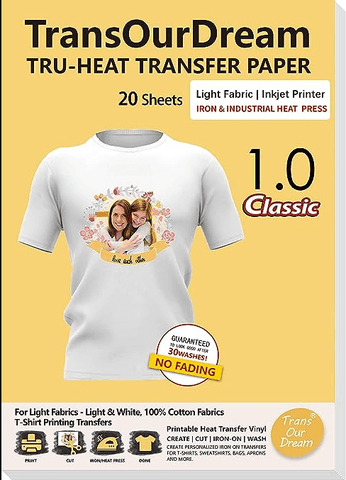
Heat transfer paper is a printable medium designed to work with standard desktop inkjet or laser printers. It's made from thin paper coated with wax and polymer layers that release the printed image onto fabric when heat and pressure are applied. If you already own a common home printer from brands like Canon, Epson, Brother, HP, or Oki, you can start making heat transfers right away — no special ink required.
Heat transfer paper is a great choice for one-time events and short runs. It supports full-color designs in a single layer, which means no weeding, no layering, and no complex multi-step workflow. You print, cut around the design, and press it onto your garment with a heat press or household iron.

However, there's a trade-off. Why does heat transfer paper crack after multiple washes? The printed layer sits on top of the fabric rather than bonding into the fibers the way HTV does. Most heat transfer paper transfers last around 25–30 wash cycles before they begin to fade and crack. That's fine for birthday shirts, family reunion tees, or short-term promotional items — but less ideal for everyday apparel or products you intend to sell.
Two details to keep in mind: inkjet and laser printers require different types of heat transfer paper, and there are separate versions designed for light and dark fabrics. Always check the product specifications before purchasing.
What Is Printable HTV?
Printable heat transfer vinyl (HTV) is a professional-grade material that delivers full-color results with a dramatically different production setup. Unlike heat transfer paper, printable HTV cannot be used with a standard desktop printer. It requires a wide-format printer that uses solvent, eco-solvent, or latex inks.
These wide-format printers — from brands like Mimaki, Roland, Mutoh, and select Epson and HP models — start at roughly $5,000 USD and can cost much more. Printable HTV comes on rolls ranging from 15 to 60 inches wide, matching the scale of professional printing operations. Most printable HTV is made from polyurethane (PU) or PVC, and it's produced in both single-color and specialty finishes like glitter, holographic, reflective, glow-in-the-dark, 3D puff, and patterned.
In exchange for the higher upfront cost, printable HTV delivers:
-
Finer detail and sharper small text — standard HTV struggles with intricate designs
-
Full CMYK color range — for custom patterns, photos, and multi-color logos
-
Superior durability — printable HTV rarely cracks or fades, and with proper care it can outlast the garment
-
Production-scale output — wide rolls and commercial printing speeds for business volume
Heat Transfer Paper vs. Printable HTV: Side by Side
Both materials achieve full-color transfer without layering, but they serve very different users and budgets. Here's how they compare:
| Feature |
Heat Transfer Paper |
Printable HTV |
| Printer Required |
Standard desktop inkjet or laser printer |
Wide-format printer with solvent, eco-solvent, or latex ink |
| Initial Investment |
Low — likely already own a printer |
High — $5,000+ for an entry-level wide-format printer |
| Durability |
25–30 washes, then fades and cracks |
Typically outlasts the garment |
| Detail Level |
Good, but limited by paper texture |
Excellent — handles fine details and small text |
| Material Format |
Sheet sizes (8.5" x 11" etc.) |
Rolls, 15" to 60" wide |
| Feel on Garment |
Papery, rubbery, noticeable hand-feel |
Softer, more flexible, closer to standard HTV |
| Best For |
One-time events, hobby projects, small runs |
Custom apparel business, production runs, premium products |
Quick Decision Checklist
Use these questions to choose the right transfer method:
- ✅ Do I already own an inkjet or laser printer? → Heat transfer paper is ready now
- ✅ Am I producing more than 25 shirts at a time? → Printable HTV scales better
- ✅ Do I need prints that last beyond 25–30 washes? → Printable HTV wins
- ✅ Is my budget under $500? → Heat transfer paper is the practical choice
- ✅ Am I running a business with production volume? → Printable HTV is worth the investment
- ✅ Am I making one-off event shirts or party gifts? → Heat transfer paper keeps costs low
Frequently Asked Questions
Can I use printable HTV with an inkjet or laser printer?
No. Printable HTV requires a wide-format printer using solvent, eco-solvent, or latex ink. Standard desktop inkjet and laser printers — the same ones used for heat transfer paper — won't work. The inks simply won't bond to the vinyl surface, and the sheet-fed mechanism can't handle the material properly.
Is heat transfer paper the same as sublimation paper?
No — they are different products. Heat transfer paper is designed for standard desktop inkjet or laser printers and typically transfers at 250°F to 300°F. Sublimation paper, by contrast, requires temperatures around 400°F and works only on polyester or polyester-coated surfaces. While both use a heat press, they're not interchangeable. Sublimation paper uses a completely different ink and chemical process.
Which one is better for a beginner?
Heat transfer paper is the better starting point for beginners. It works with the printer you already have, requires no additional equipment beyond a heat press or iron, and lets you learn the workflow without a major financial commitment. Printable HTV is better suited for those who have outgrown hobby volume and are ready to invest in professional equipment.
Can I use transfer paper on dark fabrics?
Yes — but you need the right type of transfer paper. Heat transfer paper comes in separate versions for light and dark garments. Dark fabric transfer paper includes a white base layer, which prevents the fabric color from showing through the design. Always check the packaging to ensure you're using the correct type for your fabric color.
Keep Learning
Want to deepen your knowledge of heat transfer methods and materials? These guides will help:


 Cart Unlocks Add-On Deals


