Big Picture: What a Heat Press Actually Does
A heat press is a controlled machine that applies three things at once—heat, pressure, and time—to permanently bond a design onto a substrate, typically fabric. The magic lies in predictable heat transfer and mechanical force that trigger specific physical or chemical changes in inks, films, and adhesives.
This guide unpacks how the machine is built, what's happening at the material level during each transfer method, and how to apply that science to get clean, durable results every time. Whether you're pressing HTV, sublimation, or DTF transfers, understanding the "why" behind the process is what separates consistent production from trial-and-error frustration.
1. Anatomy of a Heat Press (Structure & Function)
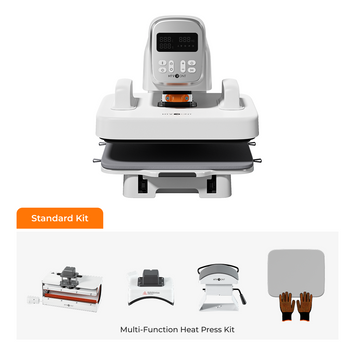
Think of a heat press as a layered system designed for uniform temperature and pressure.
How the cycle runs:
- Preheat to target temperature; 2) Place substrate and transfer; 3) Close press to apply pressure; 4) Hold for a preset time; 5) Open and peel carrier/backer per material spec (hot peel or cold peel).
Now that we've mapped out the machine's internal anatomy, let's step back and survey the different physical forms these machines take—because the right configuration depends on what you're pressing and how often.
2. Heat Press Types (At a Glance)
-
Clamshell: space‑saving, quick. Watch out for uneven pressure near the hinge.
-
Swing‑away: platen swings aside; better pressure uniformity, safer layout.
-
Draw/slide: lower platen pulls out; easier placement, good for thick garments.
-
Cap/mug/plate presses: curved platens for shaped substrates.
-
Pneumatic/auto: precise, repeatable pressure for production.
With the machine types sorted, let's get to the core of this guide: what actually happens at the material level when heat, pressure, and time combine. Each transfer method follows its own physics—and understanding that is the key to troubleshooting.
3. What Changes During Pressing? The Science by Method
Each transfer type relies on distinct thermophysical or chemical mechanisms. Let's break them down one by one.
1) HTV (Heat Transfer Vinyl/Film)
HTV is a multilayer film consisting of a protective carrier (often PET), a colored PVC or PU layer, and a heat‑activated adhesive on the back.
Key transformations during pressing:
-
Thermoplastic softening: PVC or PU softens near its glass transition/melt range, improving conformity to fabric texture.
-
Adhesive activation: Heat‑activated copolymer adhesive transitions from solid to tacky/flow state, wetting fiber surfaces.
-
Pressure-driven wetting and diffusion: Force improves intimate contact; adhesive can partially diffuse or mechanically anchor into fabric interstices.
-
Cooling and solidification: On cooling, adhesive re‑solidifies, locking the film in place.
Typical parameters: 285–320°F (140–160°C) for PU, 10–20 seconds, medium to firm pressure. Hot/warm/cold peel depends on carrier adhesive chemistry—cooler peels reduce stretch‑induced lift. Failure modes include lifting at edges (insufficient pressure/heat), shine marks (excess heat/pressure), and poor wash resistance (under‑pressing or fabric incompatibility).
2) Dye Sublimation
Sublimation inks contain disperse dyes that can vaporize and bond with polyester or polymer coatings.
📖 Read More
What Is Sublimation Ink? — Understand the chemistry behind dye sublimation and how it differs from other inks.
Key transformations during pressing:
-
Sublimation: Solid dye transitions to gas at high temperature without passing through a liquid phase.
-
Diffusion and bonding: Gaseous dye molecules diffuse into amorphous regions of polyester or polymer coatings, forming molecular‑level entanglement and strong colorfastness.
-
Heat‑activated coating: Hard goods (mugs, aluminum panels) have polyester‑type coatings that accept the dyes.
Typical parameters: 380–400°F (193–205°C), 35–60 seconds for fabric (longer for hard goods), light to medium pressure. Substrate must have high polyester content (≥65%) or polymer‑coated surfaces—cotton doesn't bind disperse dyes. Failure modes include faded prints (low temp/time), ghosting (paper shift), and color shifts from incorrect ICC profiles or temperatures.
3) DTF (Direct‑to‑Film) Transfers
DTF transfers print designs with pigment ink onto PET film, coat them with thermoplastic hot‑melt adhesive powder, then cure the film.
📖 Read More
What Is DTF Printing? — The complete DTF workflow explained, from printer to finished transfer.
Key transformations during pressing:
-
Adhesive reflow: TPU/EVA‑type hot‑melt adhesive softens/melts, flowing into fabric weave.
-
Mechanical interlocking: Under pressure, molten adhesive penetrates fiber gaps, forming a strong bond as it cools.
-
Pigment encapsulation: The printed ink layer is encapsulated beneath/within the adhesive, improving durability.
Typical parameters: 300–325°F (150–165°C), 10–20 seconds with medium to firm pressure. Cold peel is common to prevent ink lift, followed by a quick repress (2–5 seconds) with parchment or Teflon for an enhanced matte finish. Failure modes include edge cracking (over‑cured film), poor adhesion (insufficient pressure/heat), and glossy patches (over‑press with PTFE).
Each method has its own chemistry, but they all obey the same three variables. Let's zoom out and look at why heat, pressure, and time form the universal foundation of every successful press.
4. Why Heat, Pressure, and Time Matter (Process Physics)
-
Heat: Increases molecular mobility, lowers viscosity of thermoplastics, drives sublimation, and accelerates diffusion.
-
Pressure: Ensures intimate contact and consistent heat transfer; increases wetting and penetration of adhesives into fibers.
-
Time: Allows the necessary phase changes and diffusion to complete; too long can cause dye over‑migration or scorching.
Uniformity is king: Even platen temperature and consistent pressure across seams, collars, or thick hoodies determine real‑world success. Use pads, pillows, or shims to level irregular areas and preserve uniform contact.
Theory understood. Now let's translate that physics into a practical pre‑press checklist that takes seconds but saves entire batches.
5. Practical Setup Tips (Science‑backed)
-
Pre‑press garments 3–5 seconds to remove moisture and flatten fibers—water absorbs heat and can lower surface temp by tens of degrees.
-
Verify platen temperature with a surface probe or thermostrip; controllers can read hotter than the actual surface.
-
Calibrate pressure for fabric thickness: thick hoodies need more compression or a higher setting to achieve true PSI.
-
Avoid over‑stacking PTFE sheets—they insulate and reduce effective heat. Kraft paper or parchment changes heat flow less.
-
Control movement: Tape sublimation paper to prevent ghosting; let DTF cool fully before peeling if specified.
6. Quick Reference Table
Here's a compact comparison of the three common methods:
| Method |
Core Mechanism |
Typical Temp |
Time |
Pressure |
Substrate |
| HTV |
Thermoplastic/adhesive softening and bonding |
285–320°F (140–160°C) |
10–20 s |
Medium–firm |
Most fabrics |
| Sublimation |
Dye sublimation and diffusion into polymers |
380–400°F (193–205°C) |
35–60 s |
Light–medium |
Polyester/polymer‑coated |
| DTF |
Hot‑melt adhesive reflow + pigment transfer |
300–325°F (150–165°C) |
10–20 s (+repress) |
Medium–firm |
Broad fabric range, incl. cotton |
The key takeaway: a heat press is a precision tool for driving controlled phase changes—softening, melting, sublimation, and diffusion—so your transfers form durable, wash‑resistant bonds. Dial in heat, pressure, and time for the specific chemistry of your transfer, and you'll get clean, lasting results.
7. Frequently Asked Questions
Why does my heat press temperature reading differ from the actual platen surface?
The temperature sensor is often embedded inside the platen, not on the surface. Heat loss to the air and the time it takes for heat to conduct through the aluminum means the surface can be 10–20°F cooler than the display reading. Always verify with an external IR thermometer or surface temperature strips, and allow 3–5 minutes of preheat time even after the display reaches the target number.
What's the difference between how HTV and sublimation bond to fabric?
HTV uses a heat-activated adhesive that melts, flows into the fabric fibers, and re-solidifies on cooling—creating a mechanical bond that sits on top of the fabric. Sublimation ink turns directly into a gas and diffuses into polyester molecules at the molecular level, becoming part of the fabric itself. This is why sublimation has no texture and won't peel, but only works on polyester, while HTV works on most fabrics but can crack or lift over time.
How does DTF differ from HTV in terms of the science?
DTF uses a hot-melt adhesive powder that's pre-cured onto the printed film before pressing. During the heat press cycle, this powder re-melts and flows into the fabric under pressure, encapsulating the printed ink layer within the adhesive. HTV bonds a solid colored film with adhesive already attached. DTF can achieve more detailed, full-color prints than HTV because the design is printed with ink rather than cut from colored vinyl sheets.
Why does pressure matter as much as temperature?
Without adequate pressure, heat transfer is inefficient—gaps between the platen and the fabric create insulating air pockets. Pressure also physically forces softened adhesive or molten powder into the fabric weave, creating the mechanical interlocking that determines wash durability. Too little pressure causes edge lifting; too much can squeeze adhesive out the sides or create unwanted texture on the fabric surface.
How does pre-pressing improve transfer quality?
Pre-pressing removes moisture trapped in the fabric fibers. When residual moisture hits the heat press, it turns to steam, which can lift the transfer, create bubbles, or reduce the effective surface temperature by absorbing heat energy. Pre-pressing also flattens wrinkles and warms the fabric, improving initial contact between the adhesive and the fibers for a stronger bond from the first second of the press cycle.


 Cart Unlocks Add-On Deals