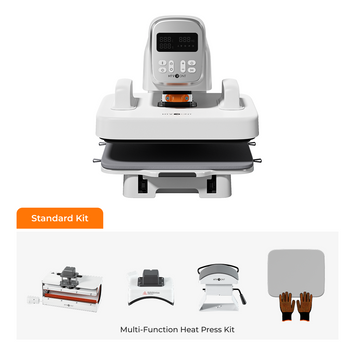
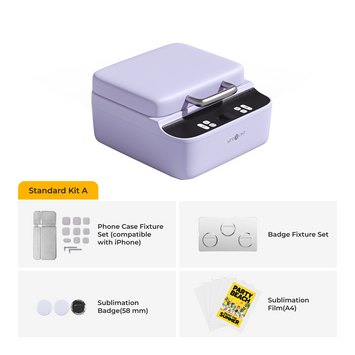
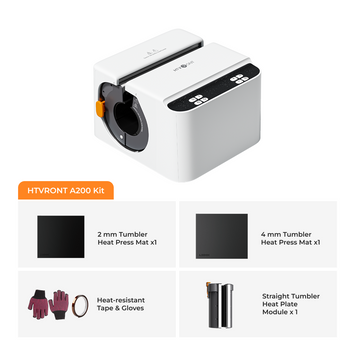
This guide helps you quickly find the right HTVRONT heat press settings for A100 Auto Multi Heat Press, A200 Auto Tumbler Heat Press, H17 Phone Case Heat Press, H10 Handle T Shirt Press, A300 Auto Hat Press, Auto Heat Press 2, Mini Heat Press, HTV, sublimation, DTF film, transfer paper, hats, tumblers, mugs, phone cases, badges, and everyday DIY projects.
Use the Quick Jump below to find your machine model, or start with the material-based settings chart to match your project type.
Quick Jump to Heat Press Settings
Choose a quick answer, material summary, or machine model below to jump directly to the heat press temperature, time, pressure, peel settings, tumbler settings, phone case heat press settings, or T-shirt press settings you need.
Quick Answer: What Heat Press Settings Should I Use?
For most standard HTV projects, a good starting heat press setting is 145–150°C for 15 seconds with firm pressure and cold peel.
For sublimation on polyester, start around 200°C for 40 seconds with firm pressure and hot peel.
Specialty materials need more specific settings. Puff HTV usually works best around 155°C for 15 seconds with hot peel, DTF film commonly starts around 150°C for 15 seconds with cold peel, and transfer paper often starts around 160°C for 20 seconds with cold peel.
For A100 Auto Multi Heat Press, choose the matching flat, hat, or tumbler module first, then follow the material-specific settings in the A100 chart below.
For A200 Auto Tumbler Heat Press projects, use 200°C / 390°F as the main starting temperature, then adjust time, pressure, and heat press mat according to tumbler size, mug size, material, and design coverage.
For H17 Phone Case Heat Press projects, phone cases usually start at 135°C / 275°F on both upper and lower plates for 300–350 seconds with hot peel. Because H17 uses heat and vacuum adsorption for shaped sublimation blanks, always use the correct fixture set.
For H10 Handle T Shirt Press projects, most standard HTV materials start at 145–150°C / 295–300°F for 15 seconds. Use 22–27 kg / 49–59 lb pressure for most HTV, and 25–30 kg / 55–66 lb pressure for DTF film, transfer paper, sublimation paper, and hotfix rhinestones.
These are general starting points. For the most reliable result, always check the model-specific chart below and test on scrap material before pressing your final project.
Need Fahrenheit Heat Press Settings?
Many HTVRONT heat press settings are listed in Celsius because Celsius is commonly used in our testing data and machine settings.
For U.S. readers who prefer Fahrenheit, use the quick conversion guide below when comparing temperature settings.
125°C = 257°F
135°C = 275°F
140°C = 284°F
145°C = 293°F
150°C = 302°F
155°C = 311°F
160°C = 320°F
175°C = 347°F
180°C = 356°F
190°C = 374°F
200°C = 392°F
220°C = 428°F
Tip: If your machine displays Fahrenheit, choose the closest available temperature and run a small test press before starting production.
Quick Heat Press Settings by Material
If you are not sure which model section to use yet, start by matching your material type first.
This quick heat press settings chart gives you a general temperature, time, pressure, and peel reference before you check the exact HTVRONT machine settings below.
These material-based heat press settings are general starting points. Always check your machine-specific chart and the instructions that come with your vinyl, sublimation blank, DTF film, transfer paper, tumbler, mug, phone case, badge, fixture, or heat press mat.
Cotton vs Polyester Heat Press Settings: What's Different?
Cotton usually tolerates slightly higher heat, while polyester is more sensitive to scorching, shine marks, and dye migration.
This is why polyester projects often need slightly lower HTV temperatures or a careful test press before production.
Before Using Heat Press Settings — Golden Rules
The best heat press setting only works when your machine, material, and peeling method are prepared correctly.
Before applying any temperature or time setting, follow these practical habits to prevent uneven transfers, weak adhesion, scorching, and peeling problems.
1Preheat for consistency — Always preheat your press to the target temperature before use. Uneven heat can lead to patchy or incomplete transfers.
2Test before production — When using a new material or substrate, test on scrap material before pressing your final design.
3Peel correctly — Standard HTV and many transfer papers usually need cold peel, while puff HTV and sublimation often require hot peel.
4Stay safe — Keep hands and flammable materials away from the heated plate. Heat presses are powerful tools, not hand warmers.
?Why is my vinyl peeling after washing? Common causes include low pressure, not enough press time, peeling too early, washing too soon, or using a temperature setting that is too low for the adhesive to bond properly.
?Why does my sublimation look faded after pressing? Faded sublimation usually comes from low temperature, short pressing time, poor coating, weak ink transfer, or fabric with too much cotton content.
HTVRONT Heat Press Settings Chart by Model
This chart shows the recommended heat press temperature, time, pressure, peel method, tumbler-specific settings, phone case heat press settings, and T-shirt press settings for HTVRONT models.
Find your machine, match your material type, and use the setting as your official starting point before testing on your final project.
Compatible Projects: Flat garments, T-shirts, tote bags, hats, caps, tumblers, mugs, and sublimation drinkware when used with the matching A100 module.
✓Why A100 is different: Unlike a single-purpose press, A100 is built as a multi-function heat press system. It supports flat pressing, hat pressing, and tumbler pressing through quick-swap modules.
✓Best for multi-project creators: A100 is especially useful for users who make shirts, hats, and drinkware but prefer one automatic system instead of several separate machines.
Flat Press Heat Press Settings
Hat Press Heat Press Settings
Tumbler & Mug Heat Press Settings
New to A100? Learn how this auto multi heat press works and how it supports flat, hat, and tumbler projects with one quick-swap system.
Compatible Fabrics: 100% cotton, polycotton, polyester, and similar hat fabrics.
Basic HTV Heat Press Settings
Sublimation Heat Press Settings
Compatible Fabrics: 100% cotton, 100% polyester, blends, modal, and canvas.
Basic HTV Heat Press Settings
Special Processing Heat Press Settings
Compatible Projects: 15/20 oz stainless steel tumblers, 30 oz stainless steel tumblers, 16 oz glass tumblers, 40 oz tumblers with handle, 11 oz mugs, and 15 oz mugs.
A200 Tumbler & Mug Heat Press Settings
✓Mug pressing note: For light-colored designs, reduce the recommended pressing time by 10–20 seconds.
✓Dark or large-area designs: For dark-colored or large-area designs, increase the recommended pressing time by 50–70 seconds.
These A200 tumbler heat press settings are based on the official HTVRONT quick reference chart. Always confirm that the tumbler diameter, pressure range, and heat press mat match your blank before pressing.
Compatible Projects: TPU / PC phone cases, metal badges, ceramic plates, leather coasters, MDF keychains, and shaped sublimation blanks that match the recommended H17 fixtures or base plate.
✓Why H17 is different: H17 is not a regular flat press. It combines heat with vacuum adsorption so the sublimation film can wrap more closely around curved or irregular surfaces.
✓Best for shaped sublimation blanks: Use H17 when pressing phone cases, badges, ceramic plates, coasters, and keychains that need tighter film contact than a flat heat press can provide.
H17 Phone Case & Shaped Blank Heat Press Settings
These H17 phone case heat press settings are based on the official HTVRONT quick reference chart. For best results, match the correct fixture set or base plate to your sublimation blank, and test before pressing production items.
Compatible Projects: T-shirts, tote bags, flat garments, small apparel projects, HTV, DTF film, transfer paper, sublimation paper, and hotfix rhinestones on suitable fabrics.
✓Why H10 is different: H10 upgrades the older single-handle T Shirt Press with a dual-handle design for steadier two-handed pressing and more comfortable operation.
✓Pressure sensing: H10 includes built-in pressure sensing, helping users apply and monitor pressure more accurately during heat transfer projects.
H10 T Shirt Press Heat Press Settings
These H10 T Shirt Press settings are based on the official HTVRONT quick reference chart. Use the built-in pressure sensing display to help keep pressure within the recommended range for each material.
Compatible Fabrics: 100% cotton, polyester, blends, modal, and canvas.
Fabric Heat Press Settings
Mug Press Application Settings
Tumbler & Drinkware Heat Press Settings
Fabric & Material Heat Press Settings
!Auto 1 usage note: DTF film, white toner, silk screen, 3D puff HTV, oversized garments, and uneven ceramic surfaces may require stronger or more specialized pressure control than Auto 1 can provide.
Compatible Fabrics: Cotton, polyester, blends, canvas, and modal.
Manual Heat Press Settings
Previous T Shirt Press Heat Press Settings
Compatible Fabrics: 100% cotton, 100% polycotton, and polyester.
Manual Hat Heat Press Settings
Material Storage Tips
Proper storage helps HTV, sublimation paper, and specialty transfer materials perform more consistently.
Temperature, humidity, and sunlight can affect adhesive performance, color stability, and transfer quality.
✓Temperature-sensitive materials, such as color-changing and holographic HTV, should be stored at around 20±2°C and kept away from direct sunlight.
✓Humidity-sensitive materials, such as flocked and metallic HTV, should be kept below 40% relative humidity. Place desiccants in sealed bags to maintain optimal conditions.
Quick Heat Press Settings Checklist
Before every heat press project, confirm your machine, material, temperature, time, pressure, and peel method.
This quick checklist helps you avoid the most common setup mistakes before you press.
- Confirm your HTVRONT heat press model.
- For A100, choose the correct flat, hat, or tumbler module before checking settings.
- For A200, confirm tumbler diameter, cup size, pressure range, and matching heat press mat.
- For H17, choose the correct phone case fixture, badge fixture, or base plate before setting upper and lower heat plate temperatures.
- For H10, use the built-in pressure sensing display to keep pressure within the recommended range for HTV, DTF film, transfer paper, sublimation paper, or hotfix rhinestones.
- Match your material type to the correct heat press settings chart.
- Preheat the machine to the target temperature setting.
- Pre-press fabric to remove moisture and wrinkles.
- Test on scrap material before pressing the final design.
- Use the recommended hot peel or cold peel method.
- Let the finished item cure before washing when required.
Frequently Asked Questions About Heat Press Settings
These heat press settings FAQs answer the problems users most often search for when transfers peel, fade, bubble, crack, or discolor.
Use them as quick troubleshooting notes alongside the model-specific chart above.
1What are the best heat press settings for HTV?
For most standard HTV, start with 145–150°C for 15 seconds using firm or high pressure. Specialty HTV may need different settings: metallic HTV often uses lower temperature, while puff HTV usually requires hot peel.
2What temperature should I use for cotton vs polyester?
For most HTV on cotton, start at 145–150°C for 15 seconds. For polyester, reduce to 140–145°C to help prevent scorching, and always pre-press to remove moisture.
3Why is my heat transfer uneven or discolored?
Uneven or discolored transfers are often caused by incorrect temperature, short pressing time, uneven pressure, moisture in the fabric, or inconsistent contact between the material and heat plate.
4Why does my vinyl bubble or crack when peeling?
Vinyl can bubble or crack if the peel method is wrong, the material is peeled too early, the pressure is uneven, or the press time is too short. Always follow the hot peel or cold peel recommendation for your material.
5How do I fix HTV sticking to the heat press plate?
Keep the heat press plate clean and remove residue promptly. A Teflon sheet or protective cover sheet can help prevent HTV from contacting the plate directly during pressing.
6Can I use the same heat press settings for every machine?
No. Different heat press models may apply heat and pressure differently, even when the displayed temperature is the same. Use this chart as a model-specific starting point, then test on scrap material before pressing your final project.
7Do I need to pre-press fabric before applying HTV?
Yes. Pre-pressing helps remove moisture and wrinkles from the fabric, which improves adhesive contact and reduces the risk of peeling, bubbles, or uneven transfers.
8How long should I wait before washing a heat-pressed shirt?
For most HTV projects, wait at least 24 hours before washing. Turn the garment inside out, use cold or mild water, and avoid high heat drying to help protect the transfer.
9What is the HTVRONT A100 Auto Multi Heat Press best for?
The A100 is best for creators who want one automatic system for flat projects, hats, and tumblers. It handles T-shirts, caps, mugs, tumblers, and tote bags efficiently.
10What are the best settings for the HTVRONT A200 Auto Tumbler Heat Press?
Start at 200°C / 390°F. Stainless steel tumblers: 180–220 sec. Glass tumblers: 290–320 sec. 11 oz mugs: ~420 sec. 15 oz mugs: ~520 sec. Always match the recommended pressure and heat press mat to your blank size.
11What are the best settings for the HTVRONT H17 Phone Case Heat Press?
For phone cases: 135°C / 275°F on both plates, 2–10 sec preheat, 300–350 sec transfer, hot peel. For metal badges: 140°C / 285°F for ~330 sec.
12What are the best settings for the HTVRONT H10 Handle T Shirt Press?
For standard HTV: 145–150°C / 295–300°F for 15 sec with 22–27 kg pressure and cold peel. For DTF film and transfer paper: 25–30 kg pressure. For sublimation: 200°C for 40 sec.
Heat Press Settings: Final Tips & Troubleshooting Summary
The official HTVRONT heat press settings chart is a tested starting point, not a substitute for material-specific testing.
Fabric content, coating quality, room humidity, equipment condition, substrate shape, pressure feedback, and fixture fit can all slightly affect the final result.
✓The heat press settings in this guide are based on testing, but actual results may vary slightly by material, coating, environment, and equipment condition.
✓For new materials or high-volume production, run test prints first to find the best temperature, time, pressure, fixture, mat, and peel combination for your workflow.
✓Clean the heat press plate, mat, fixture, and working surface regularly to extend machine life and improve transfer consistency.
With the HTVRONT heat press settings chart above, you can avoid most common heat press mistakes while maximizing material efficiency. Reliable transfer results come from precise parameters, careful testing, and high-quality tools.
If you have any questions, contact HTVRONT customer service. Our team will provide full support.
Why this guide was updated: This article was first published on February 12, 2025. It has been updated to include the latest HTVRONT heat press models — including the A100 Auto Multi Heat Press, A200 Auto Tumbler Heat Press, H17 Phone Case Heat Press, and H10 Handle T Shirt Press — with settings current for 2026 users. We also simplified the layout to make it easier to scan on desktop and mobile.
Keep Learning with HTVRONT
Keep building your heat transfer skills with official HTVRONT tools, materials, manuals, and video tutorials.
These resources help you move from heat press settings to better real-world projects.


 Cart Unlocks Add-On Deals